Diversity at the Iftar Table: Why Indonesia’s Food Resilience Is Not Just About Rice
February 27, 2026 23:53
Diversity at the Iftar Table: Why Indonesia’s Food Resilience Is Not Just About Rice
Ramadan is one moment that is deeply anticipated by Muslim communities around the world, including in Indonesia. During this month, food becomes more than a daily necessity. It reflects culture, togetherness, and living traditions that connect communities across generations.
As the sun sets, iftar tables across the archipelago tell different stories. In one region, families gather around bowls of kolak; in another, papeda or boiled sweet potatoes are served. Traditional market snacks, seasonal fruits, and local dishes that appear only at certain times of the year fill homes and streets alike. Without us always realizing it, these meals reveal an important truth: food diversity is neither distant nor difficult to achieve. It already lives within Indonesian society, shaped by diverse cultures, landscapes, and local wisdom across regions.
Yet behind this abundance lies a question that often goes unnoticed: how resilient is the food system that sustains Indonesia's everyday meals?
This question may feel far removed from the warmth of a full iftar table. But for many communities across Indonesia, it is a matter of long-term food security.
A 2020 TJF Brief highlighted one stark example. In 2018, Asmat Regency experienced a hunger crisis that led to severe malnutrition and claimed 71 lives. The crisis was closely linked to heavy dependence on a single staple commodity, rice, without alternative carbohydrate sources as a buffer. Although Asmat is not a rice-producing region, reliance on rice had gradually displaced traditional food systems based on sago and tubers. When rice supplies declined and distribution chains faltered, the region faced acute food vulnerability.
Asmat is not an isolated case. Many regions in Indonesia depend heavily on long and fragile food distribution chains, particularly areas that do not produce their own staple foods and rely primarily on a single commodity such as rice.
This situation is rooted in historical policy choices. During the New Order era in the 1970s, national food self-sufficiency efforts focused heavily on rice production. Large-scale development of rice-growing centers across the country shaped public perception and firmly positioned rice as Indonesia's primary staple. Consumption patterns shifted accordingly. By 2010, rice dominance had strengthened while many local food sources became increasingly marginalized. Although food diversification initiatives were introduced, including Presidential Instruction No. 20 of 1979, their implementation struggled to balance the much stronger policy emphasis on rice self-sufficiency.
Strengthening Food Security Through Diversification
Recent crises have demonstrated that food security is not defined solely by high production levels. It also depends on the diversity of food sources and the accessibility of food at the local level. Food diversification that prioritizes local production therefore becomes a key strategy for strengthening national food resilience. By reducing dependence on a single commodity, diversification helps lower vulnerability to supply disruptions and external shocks.
The 2020 TJF Brief identifies two complementary approaches: horizontal and vertical diversification. Horizontal diversification expands the variety of staple crops, for example by increasing the production of cassava and sweet potatoes alongside rice. Vertical diversification focuses on how commodities are processed and utilized. Tubers, for instance, can be developed into chips, flour, or other food products rather than sold solely as raw harvests. Beyond enriching dietary diversity, vertical diversification also creates opportunities for added economic value for farmers and local communities.
How ready is Indonesia to advance these approaches?
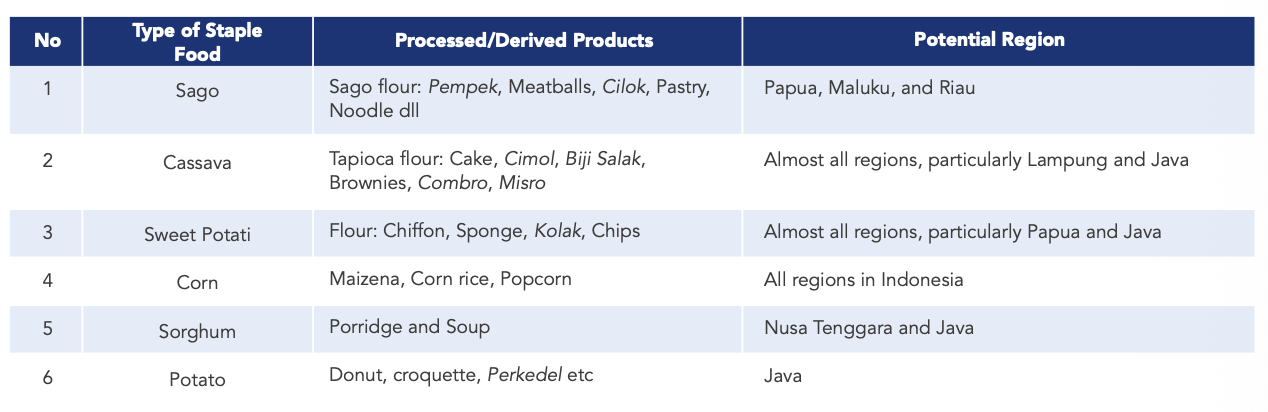
Indonesia already holds strong potential. The country has significant opportunities to develop sago, sorghum, cassava, and sweet potatoes as viable alternatives to rice-based carbohydrates. Indonesia is home to approximately 83 percent of the world's sago forests. At the same time, many suboptimal lands are already being cultivated by local communities as alternative food sources, although these initiatives often lack sufficient policy support.
Positive signals are also emerging from society itself. Nationally, demand for fish, meat, fruits, and vegetables continues to increase each year, indicating growing openness toward more diverse and nutritious diets. In Papua, communities are returning to sago consumption, while in East Nusa Tenggara, sorghum is gradually reappearing on dining tables. Local food traditions that were once marginalized are slowly reclaiming their place. What is needed now is systematic government support through policies that recognize and value the diversity of local food systems across regions.
Table 1. Opportunities for Alternative Staple Foods to Replace Rice and Wheat
Source: Adapted from Ministry of Agriculture data (2018)
Food diversity has long been part of Indonesian society. The challenge today is not to create it from scratch, but to protect and strengthen what already exists. This requires policies that support local food production, improve equitable access, and recognize that true food resilience cannot depend on a single commodity. Each Ramadan reminds us that diversity is a source of strength. It is time for Indonesia's food system to reflect that same principle.
Tay Juhana Foundation remains committed to supporting the sustainable development of suboptimal lands into productive landscapes as part of broader efforts to strengthen Indonesia's food resilience. Learn more about our programs and research through our Instagram and LinkedIn platforms.
Category
Research Article
Topic
Agriculture
Farmer Empowerment
Food Security
Peatland Agriculture Sustainability
Suboptimal Land
Landscape
Livelihood
Peatland
Suboptimal Land
Share This Article


RELATED
ARTICLE
Landmark Pluit Building-2nd Floor, Tower D6, RW.4, Pluit, Kecamatan Penjaringan, Jakarta Utara, Daerah Khusus Ibukota Jakarta 14440
Phone: (021) 6603926
WhatsApp: +62 815 8855 584
Follow our social media:
![[object Object]](/icons/instagram.svg)
![[object Object]](/icons/facebook.svg)
![[object Object]](/icons/youtube.svg)
![[object Object]](/icons/linkedin.svg)
Privacy Policy
Copyrights © 2026 Tay Juhana Foundation