Three Storms, One Farm: Wetland Agriculture Under Indonesia's Converging Crises
May 19, 2026 14:23
Three Storms, One Farm: Wetland Agriculture Under Indonesia's Converging Crises
In April 2026, the World Meteorological Organization (WMO) signalled a clear shift: sea-surface temperatures in the Equatorial Pacific are rising rapidly, pointing to a likely return of El Niño conditions as early as mid-2026. WMO noted that climate models are now pointing in the same direction, confirming that El Niño is coming and expected to strengthen as the year progresses. The National Oceanic and Atmospheric Administration (NOAA) Climate Prediction Center puts the probability at 82% for May-July 2026.
Early signs are already showing up over Indonesia. According to NOAA's ENSO Diagnostic Discussion, atmospheric data recorded drier and clearer skies with reduced rainfall than usual over the archipelago in April and May 2026, a pattern that typically signals the early arrival of El Niño conditions. In Indonesia, BRIN has also warned of a potentially strong El Niño severe enough to trigger prolonged drought, crop failures, and rising food prices, a phenomenon some have come to call "Godzilla El Niño," as reported by CNBC Indonesia.
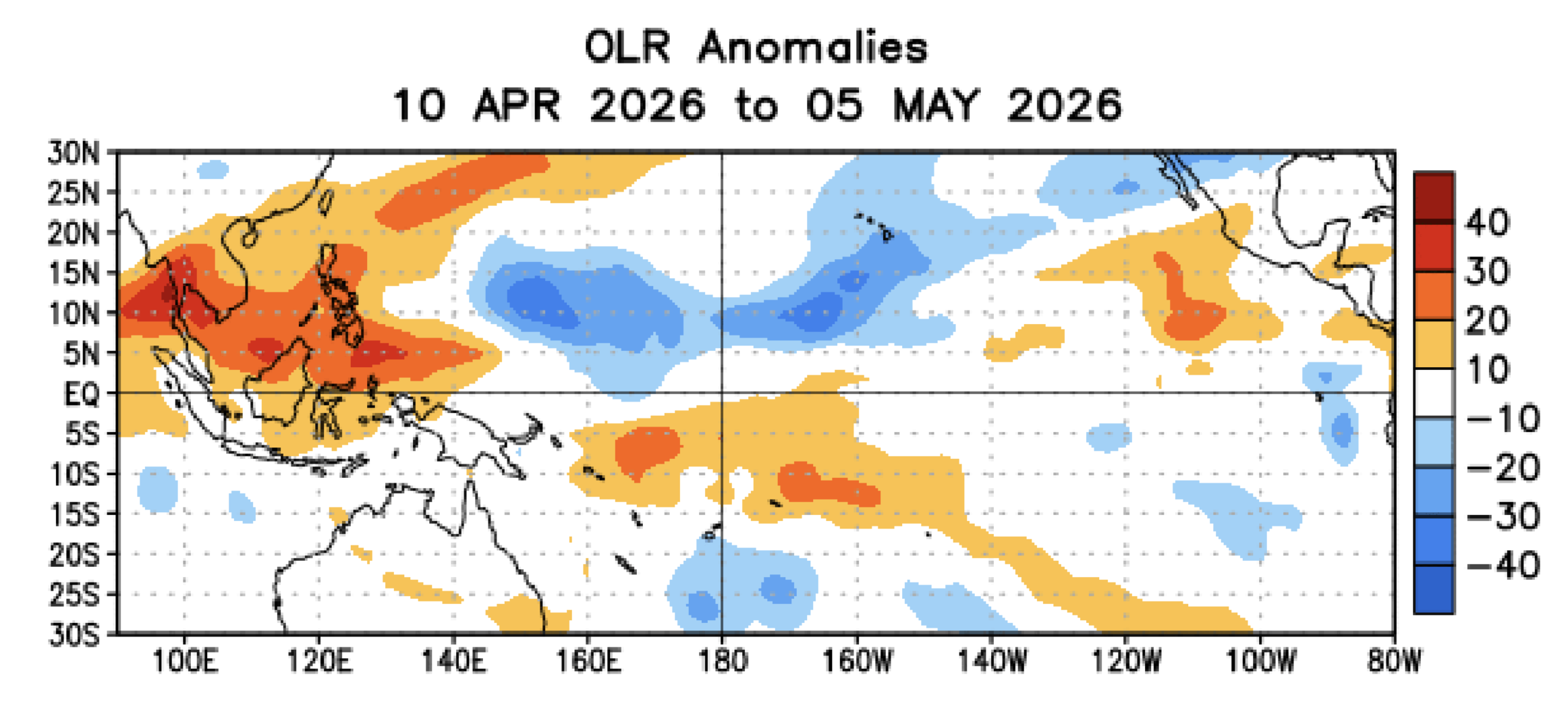
Figure 1. Drier and clearer-than-usual sky conditions over Indonesia and surrounding regions, recorded between 10 April and 5 May 2026. Orange and red areas indicate less rainfall and cloud cover than normal, while blue areas indicate more. Indonesia's position in the deep orange zone signals an early pattern consistent with El Niño onset. (Source: NOAA)
The concern is well-founded historically. FAO's Special Report on Indonesia documented that the 1997/98 El Niño pushed national paddy production down by around 8% compared to the previous year. More recently, BPS data reported by Kompas.id showed that the 2024 El Niño caused a decline of 1.91 million tons in rice output in just the first four months of that year, as harvest areas shrank by over 15% compared to the same period in 2023.
But the climate threat is not arriving alone. In early 2026, disruptions to global shipping corridors sharply tightened fertilizer supplies, causing urea prices to nearly double for smallholder farmers that are already operating on thin margins. At the same time, Indonesia has declared full food self-sufficiency and halted rice imports entirely. This means there is no longer an easy safety net when domestic production falls short. It is also worth noting that Indonesia's food system has long been heavily centred on rice as its primary staple, making it especially sensitive to any disruption in rice production. In this context, Indonesia's vast wetland landscapes present an opportunity worth exploring, though one heavily shaped by how they are managed.
These three crises are converging at once: a climate shock, a fertilizer price surge, and the weight of national food sovereignty. For those farming Indonesia's vast wetland landscapes, how well these pressures are weathered depends greatly on how well their land management practices have prepared them.
The Land That Holds Water
Indonesia is home for 39.6 million hectares of wetlands—peatlands, swamps, and tidal flats covering roughly 21% of the country's land area, concentrated primarily in Sumatra, Kalimantan, and Papua. For decades, these landscapes have been written off as sub-optimal: too wet, too acidic, too difficult. They have been drained for plantations, burned for land clearing, or simply abandoned.
That perception needs to change. TJF's March 2026 Research Brief on Wetland Management Techniques for Sustainable Agriculture argues that wetlands, when managed correctly, are among Indonesia's most resilient agricultural frontiers. Their natural characteristics, which are water-retaining soils and organic-rich earth, provide the raw foundation. Though, it is the application of proper management techniques, particularly interconnected canal systems that regulate rather than drain water, that unlocks their capacity to absorb shocks that would devastate conventional farms.
The proof is already in the field.
In Pulau Burung, Indragiri Hilir, Riau, TJF has studied a peatland coconut plantation managed using the Water Management Trinity (Trio Tata Air, or WMT) since the mid-1980s. Unlike conventional drainage systems that move water out of the land, the WMT does the opposite, it keeps water in, using a network of canals and sluice gates to regulate levels through both wet and dry seasons.
What the 2019 Drought Revealed
During Indonesia's severe El Niño drought in 2019, TJF researchers monitored water table depth across the WMT area every two weeks throughout the entire dry season. The results, published in the peer-reviewed paper "Alleviating Peatland Fire Risk Using Water Management Trinity and Community Involvement" (Fawzi, Qurani & Darajat, IOP Conference Series, 2021), showed that even at the height of the drought, the average water table inside the WMT zone never dropped below 71 centimetres, which is within the range adequate for both crop productivity and fire prevention.
NASA satellite data confirmed what the field team observed: hotspot density inside the WMT area was dramatically lower than in surrounding unmanaged plantations during the same drought period. No burned area was found inside the WMT zone.
This is not modelled or projected. It is recorded, peer-reviewed evidence, from a real El Niño drought, on a farm that has been continuously managed for over three decades.
Beyond Water: Cutting the Fertilizer Dependency
Water management is the foundation, but not the whole story. The same TJF research brief also documents soil practices that speak directly to the fertilizer crisis. Applying agricultural lime (dolomite) neutralises peat's chronic acidity without synthetic inputs. Compost and crop residues rebuild soil fertility from within. And mina padi (the traditional practice of raising fish in flooded rice paddies) generates natural fertilizer from fish waste while producing an additional source of food and income from the same plot.
A farm running on these integrated systems is not immune to a fertilizer price shock. However, it is structurally insulated from the worst of it.
Standing on Different Ground
When drought intensifies and input prices rise, farmers equipped with these systems are simply better prepared to endure difficult seasons. With proper water management, their land can hold water even in times when rain is scarce. With organic soil inputs, fertility can be maintained without excessive dependence on volatile synthetic fertilizers. With integrated farming systems, their paddy field gives them more than one thing to harvest.
This is what sustainable wetland management ultimately means in practice. Not just better yields, but a farmer with a foundation strong enough to face a difficult season and still come out the other side.
To stay connected with these issues and learn more about sustainable agriculture for food resilience, follow our journey on Instagram and LinkedIn.
References
Araaf, R.T. & Gultom, P.M. (March 2026). Wetland Management Techniques for Sustainable Agriculture. TJF Research Brief. Tay Juhana Foundation, Jakarta. https://be.tayjuhanafoundation.org/storage/742/01KNRMYFXM9HNA1GGBB37HBF5T.pdf
CNBC Indonesia. (2 May 2026). Super El Niño Mengintai, Bukan Cuma Gerah tapi Juga Bikin Dompet Tipis. https://www.cnbcindonesia.com/research/20260502121259-128-731682/super-el-nino-mengintai-bukan-cuma-gerah-tapi-juga-bikin-dompet-tipis
FAO. (1998). Special Report on Indonesia. https://www.fao.org/4/W9997e/W9997e00.htm
Fawzi, N.I., et al. (2024). Integrated water management practice in tropical peatland agriculture has low carbon emissions and subsidence rates. Heliyon, 10(2), e26661. https://doi.org/10.1016/j.heliyon.2024.e26661
Fawzi, N.I., Qurani, I.Z., & Darajat, R.G. (2021). Alleviating Peatland Fire Risk Using Water Management Trinity and Community Involvement. IOP Conference Series: Earth and Environmental Science. https://be.tayjuhanafoundation.org/storage/451/alleviating-peatland-fire-risk-using-water-management-trinity-and-community-involvement.pdf
FFTC Agricultural Policy Platform. (2025). Strategic Staple Crop Diversification for Indonesia's Food Sovereignty: Policy, Regulation, and Institutional Framework. https://ap.fftc.org.tw/article/3861
Kompas.id. (15 October 2024). Rice Production Down 760,000 Tons, Imports Reach 3.23 Million Tons. https://www.kompas.id/artikel/en-produksi-beras-turun-760000-ton-impornya-tembus-323-juta-ton
Margono, B.A., Bwangoy, J.R.B., Potapov, P.V., & Hansen, M.C. (2014). Mapping wetlands in Indonesia using Landsat and PALSAR data-sets and derived topographical indices. Geo-spatial Information Science, 17(1), 60–71. https://doi.org/10.1080/10095020.2014.898560
NOAA Climate Prediction Center. (May 2026). ENSO Diagnostic Discussion. https://www.cpc.ncep.noaa.gov/products/analysis_monitoring/enso_advisory/ensodisc.pdf
World Meteorological Organization. (24 April 2026). WMO: Likelihood Increases of El Niño. https://wmo.int/media/news/wmo-likelihood-increases-of-el-nino
Tay Juhana Foundation is a Jakarta-based nonprofit working toward sustainable agriculture on suboptimal lands, supporting communities and ecosystems to thrive together.
Category
Research Article
Topic
Agriculture
Farmer Empowerment
Food Security
Peatland Agriculture Sustainability
Suboptimal Land
Landscape
Livelihood
Climate Resilience
Share This Article


RELATED
ARTICLE
Landmark Pluit Building-2nd Floor, Tower D6, RW.4, Pluit, Kecamatan Penjaringan, Jakarta Utara, Daerah Khusus Ibukota Jakarta 14440
Phone: (021) 6603926
WhatsApp: +62 815 8855 584
Follow our social media:
![[object Object]](/icons/instagram.svg)
![[object Object]](/icons/facebook.svg)
![[object Object]](/icons/youtube.svg)
![[object Object]](/icons/linkedin.svg)
Privacy Policy
Copyrights © 2026 Tay Juhana Foundation