FOSTER: Integrated Agriculture System (IAS) for Diversification and Resilience Means on Suboptimal Land
August 26, 2026 14:52
FOSTER: Integrated Agriculture System (IAS) for Diversification and Resilience Means on Suboptimal Land
Along the southern coast of Indragiri Hilir, Riau, on the eastern side of Sumatra, the soil is acid sulfate in clay form, with a naturally low pH that challenges food production, making it a type of suboptimal land for agriculture. Coconut has long been the dominant crop in this region, partly because it is one of the few crops that tolerates these conditions well, and largely because it is the one crop that the community has been cultivating through generations.
Relying mainly on one crop does come with a tradeoff. When food and income depend heavily on a single source, the community becomes more exposed to shocks such as natural soil nutrient degradation or climate-related disruptions. Despite our recognition that coconut farming remains an important basis for livelihood in the region, Tay Juhana Foundation (TJF) believes that food security can be made more resilient with more diverse, accessible food sources for the local community.
Integrated Agriculture System (IAS) Approach
Among several approaches to this kind of condition, TJF explores and expands on the Integrated Agriculture System, or IAS, a concept first outlined in agricultural systems research. The basic idea is that different farming and fishery enterprises, such as a rice field, a fishpond, livestock, or a home garden, can be connected so that the output of one becomes a useful input for another. Crop residue can become feed, manure can become fertilizer, and water systems can be shared across enterprises. This kind of exchange helps enterprises use resources more efficiently, reduces reliance on costly external inputs, and can make the overall system more resilient to disruption than any single enterprise on its own.
This is not a new idea. Communities working with comparable land conditions elsewhere have applied similar integrated approaches to avoid relying on a single source of income, and to make better use of limited resources. In Bangladesh's flood-prone wetland regions, farmers who combined crop cultivation, livestock, and fish farming saw improvements in both income and overall livelihood. Closer to home, a case study on land with similarly challenging soil conditions in Minahasa Regency similarly found that integrating cattle with rice and corn farming helped make more productive use of land that conventional agriculture struggled with. For a region like southern Indragiri Hilir, where soil conditions are challenging and livelihoods are concentrated around one crop, this kind of approach offers a way to diversify food sources while making the most of what is already locally available.
TJF tries to incorporate and explore this approach through the Food Security and Sustainability Center (FOSTER), located in Tanah Merah District, Kuala Enok, Indragiri Hilir, Riau. Under this program’s umbrella, TJF aims to work toward a more sustainable and resilient food system for communities in southern Indragiri Hilir. IAS adaptation in the FOSTER program is shaped around the specific soil, water, and community conditions of Kuala Enok. The program is designed with the hope that what is learned here can also be relevant for the local communities themselves and other regions with similar land characteristics.
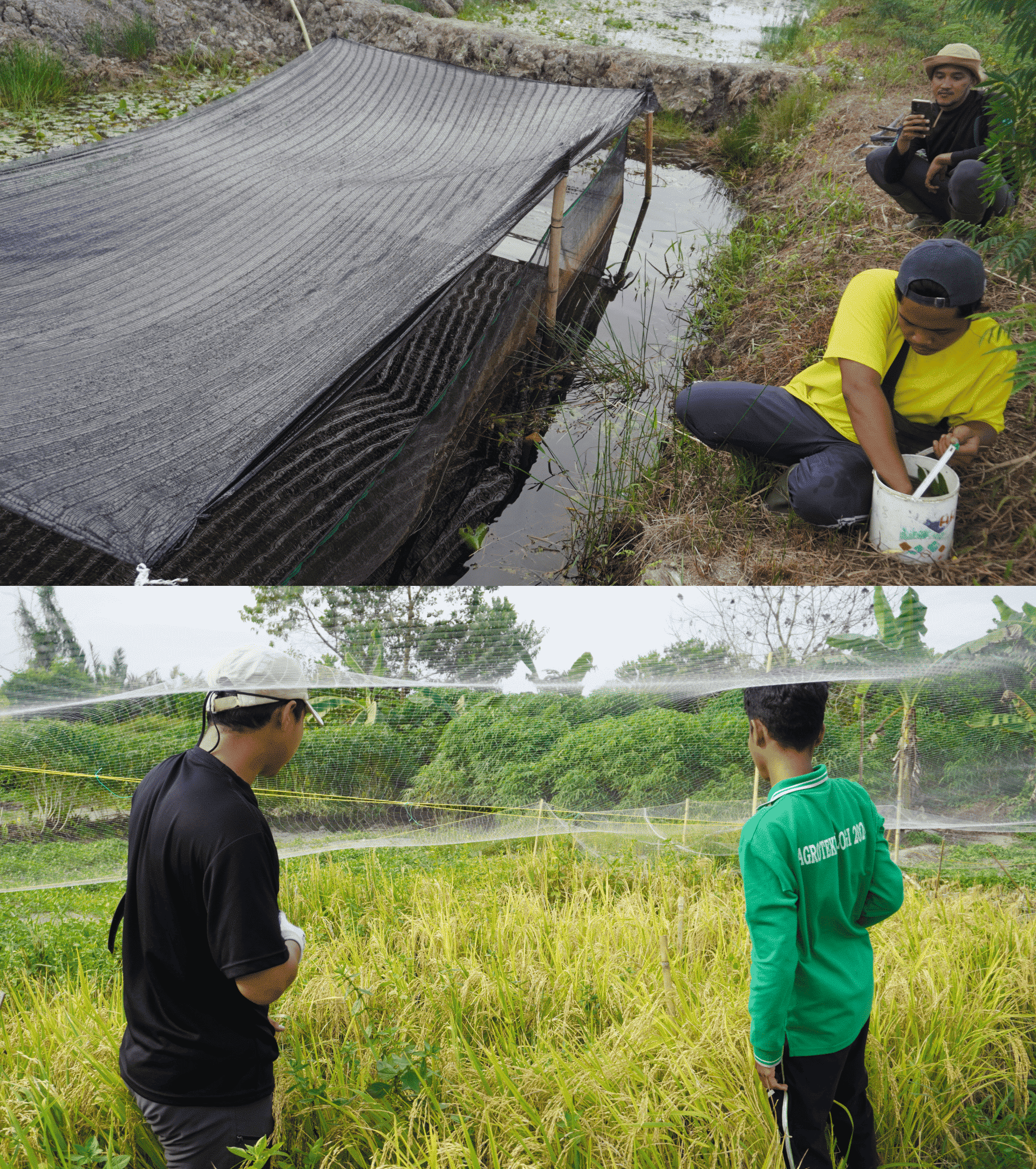
A First Look: Two Projects Underway
As an initial step, TJF began with two projects under the FOSTER umbrella, both still in an early modelling stage.
The first is a rice cultivation project, trialing different rice varieties and soil treatments on a plot of acid sulfate land in Kuala Enok, to identify combinations that perform well under the region's acidic, dry soil conditions.
The second is an aquaculture project, exploring fish cultivation in the parit, the waterways that run through the area, with a focus on approaches that make use of local resources and that are realistic for the community to maintain.
For now, these two projects are running separately, each building its own base of knowledge. As both progress, FOSTER hopes to eventually bring rice cultivation and aquaculture together into a more integrated system.
Delve deeper into the integrated vision we have outlined as well as the techniques we’ve discovered for farming in the wetlands of Indragiri Hilir through our TJF Research Brief. We will keep you updated on the projects. Don’t forget to follow us on our Instagram and LinkedIn to stay connected!
Category
Other
Publication
Topic
Agriculture
Farmer Empowerment
Food Security
Suboptimal Land
Landscape
Livelihood
Management Strategy
Suboptimal Land
TJF Update
Share This Article


RELATED
ARTICLE
Landmark Pluit Building-2nd Floor, Tower D6, RW.4, Pluit, Kecamatan Penjaringan, Jakarta Utara, Daerah Khusus Ibukota Jakarta 14440
Phone: (021) 6603926
WhatsApp: +62 815 8855 584
Follow our social media:
![[object Object]](/icons/instagram.svg)
![[object Object]](/icons/facebook.svg)
![[object Object]](/icons/youtube.svg)
![[object Object]](/icons/linkedin.svg)
Privacy Policy
Copyrights © 2026 Tay Juhana Foundation