Why Quick Fixes Fall Short in Indragiri Hilir Coconut Farming
October 27, 2026 18:11
Why Quick Fixes Fall Short in Indragiri Hilir Coconut Farming
Coconut has long been central to the socio-cultural identity and rural economy of Indragiri Hilir Regency in the Riau region and is widely known as the “World’s Coconut Heartland”. However, many don't know that it is also a “Land of a Thousand Waterways (Parit),” as traditional waterways, introduced by Bugis and Banjar migrants, crisscross the region. Occupying a tidal peatland ecosystem that covers 85% of the regency, smallholders rely heavily on these community-managed parit systems to regulate water levels under waterlogged conditions, shaping how generations have cultivated land, managed hydrology, and sustained their livelihoods.
Within the archipelago, this region has been a major coconut-producing region, yet coconut production has been falling, from around 355,000 tons in 2012 to around 311,000 tons in 2024, and this became a central focus of our research in exploring how coconut farming on peatlands, farmers, intermediaries, village governments, and others work from the plantation.
The study explored nine villages across five subdistricts that differ in institutions, water management, and market access, using a systems-thinking approach that treats the farming system as a single connected network and shows how biophysical, economic, and social factors continuously affect each other over time rather than looking at problems in isolation.
In-depth interviews with 70 informants and three focus group discussions, followed by seven Group Model Building workshops, helped show how problems connect in villages in Pulau Burung, the northern part of the regency; these plantations are accessible only by waterway. Villages in this region follow the Nucleus Estate and Smallholder (NES) scheme—locally known as Perkebunan Inti Rakyat (PIR)—where a central commercial company (inti) operates alongside partnered smallholders (plasma), using shared canal-based water management, while most others depend on independent smallholders and traditional parit.
Three Patterns, One Example
The study revealed three recurring patterns through the causal loop diagram (CLD).
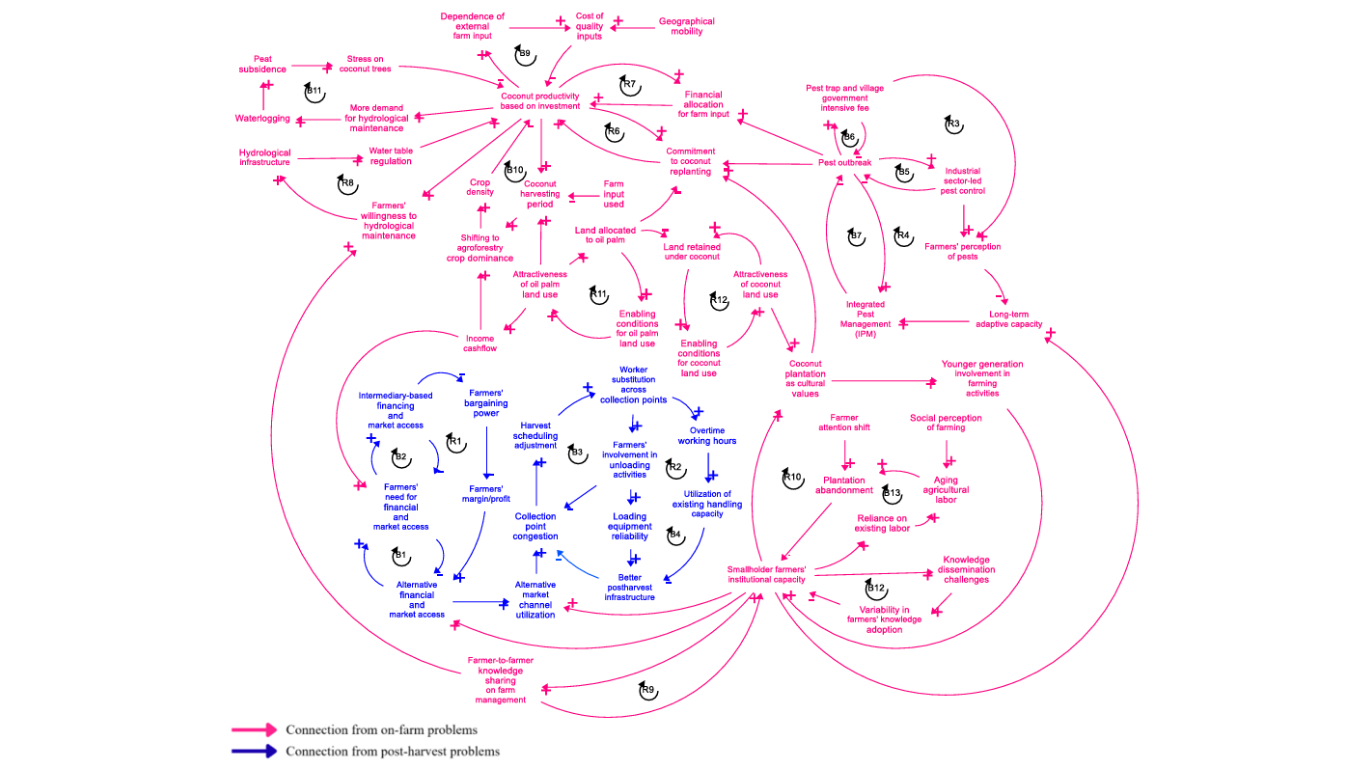
The complexity of the coconut farming system in Indragiri Hilir’s peatlands illustrated through a Causal Loop Diagram (CLD). Photo Credit: Tay Juhana Foundation/Ratu Nabillah
Shifting the burden
Firstly, quick fixes relieve immediate pressure while deepening the need for them. When cash runs short because of the long wait time for the coconut harvest, an advance payment from an intermediary is a practical lifeline. In the north, where many plantations are only accessible by river, intermediaries also collect the harvest by traditional pompong boats through complex networks before it reaches processing industries. Farmers who receive these financial advances become informally obligated to sell through the same intermediary, describing their coconuts as already “tagged” before harvest, a cycle that lowers farmers' bargaining power and profit margins and further reinforces their dependence on intermediary financing.
Limits to growth
Initial investment in replanting, inputs, and parit ditch infrastructure boosts productivity at first, but rising costs, cash-flow needs, and the demands of maintaining suitable peatland conditions slow progress because of long harvest waiting times. This pushes farmers to switch toward intercropping for immediate cash flow, which alters tree density. At the same time, ongoing peat subsidence increases flooding and waterlogging risks that harm trees and require costly, ongoing hydrological maintenance.
Success to the Successful Pattern
In contrast, success to the successful pattern depends on how coconut and oil palm compete for the same limited household farmland, each reinforced by different conditions, without one necessarily replacing the other. Conversely, coconut maintains its footprint because it is deeply tied to local cultural identity, inherited traditional knowledge, and flexible agroforestry options that cushion smallholder livelihoods.
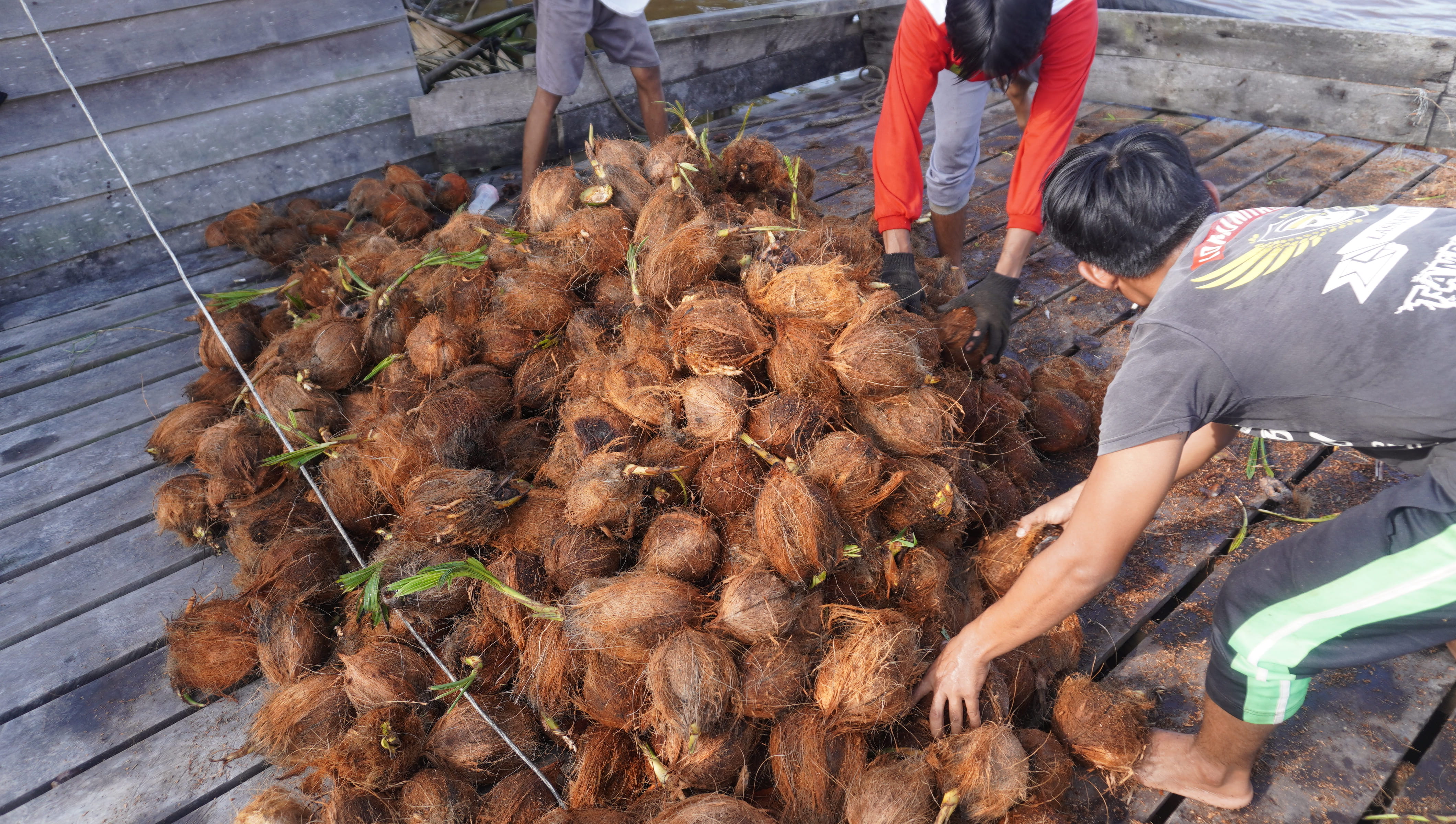
Sorting and handling harvested coconuts in the collecting point. Photo Credit: Tay Juhana Foundation/Narinda Marsha
Looking Beyond Quick Fixes
The study emphasised that this short-term fix can deepen the need for itself. Reliance on intermediary financing is linked to weaker bargaining power and thinner margins, pushing farmers back to the same financing. The wider picture is uncertainty: lower, less predictable income, combined with a long harvest cycle, reduces household cash flow and makes it harder to sustain investment in the plantation.
That need becomes more urgent as new pressures arrive. In 2026, a strong El Niño and a long dry season have intensified forest and peatland fires, known nationally as Karhutla, and fires have also been recorded in Indragiri Hilir. How this affects coconut farming communities in Indragiri Hilir Regency remains unstudied, creating an opportunity for further research. But it underscores why resilience, built on strong institutions and attention to peatland management, needs strengthening before the next disruption, not after.
At Tay Juhana Foundation, we are committed to realize a resilient local food system in the suboptimal land through sustainable agriculture. Read the full study here to see how these patterns connect, and follow our work on Instagram and LinkedIn.
Category
Topic
Share This Article


RELATED
ARTICLE
Landmark Pluit Building-2nd Floor, Tower D6, RW.4, Pluit, Kecamatan Penjaringan, Jakarta Utara, Daerah Khusus Ibukota Jakarta 14440
Phone: (021) 6603926
WhatsApp: +62 815 8855 584
Follow our social media:


Privacy Policy
Copyrights © 2026 Tay Juhana Foundation