Exploring Sustainable Aquaculture on Suboptimal Land in Kuala Enok
October 23, 2026 20:56
Exploring Sustainable Aquaculture on Suboptimal Land in Kuala Enok
On the southern coast of Indragiri Hilir Regency in Riau, a regency widely known as “The Land of a Thousand Parit”, Kuala Enok is home to both fishing and farming communities. While fishing is a main livelihood in Kuala Enok, data from Rumah Data Riau and Satu Data KKP (2023–2024) show that across the regency, most fishing still relies on capture fisheries, at roughly 94–96% of production, with aquaculture accounting for only 4–6%.
Based on the noted data, our team, through the FOSTER program, is conducting an experiment with local small-scale fish farmers to understand the potential of a locally-adapted aquaculture in Kuala Enok for a resilient local food security. This identified gap between capture fisheries and aquaculture stems from several factors, many of which coincide with the area’s natural land conditions—dominated by acid sulfate soils, where acidic pyrite can raise the acidity of the surrounding water. Small-scale fish farmers need environmentally sound ways to adapt, as modern approaches can harm the environment and damage ecosystems, which the area’s specific fragility may further intensify.
Despite these environmental constraints, aquaculture rooted in local wisdom and conditions holds significant potential for both local fishermen and farmers. With responsible management, these channels can become an affordable base for local fish farming, diversify local protein sources, strengthen food security, and provide an additional income source. Furthermore, using fishery waste in agriculture, supported by the parit network, creates a fully integrated agricultural system.
Local Waterways as a Starting Point
Our team saw parit as a starting point by understanding the water conditions where acidic pyrite accumulation affected water quality, making it hard to control the settings of a gradual experiment that began with several species: nile tilapia (nila), goramy (gurami), and shark catfish (patin). So we moved to repurposed plastic drums filled with treated field water to keep the young fish away from the acidic soil at the bottom of the parit, while learning what the parit water needs to become suitable for aquaculture. This is even more important during long dry seasons, when conditions are harder for early-stage fish rearing, and we see this as a constant adaptation during the experiment as part of the work.
That same lesson shaped our choice of species, as we are now also raising snakehead (gabus), a local fish that has shown the strongest resilience to local conditions so far. It reminds us to always return to this: innovation works best when it adapts to the land, water, and species already present, rather than arriving as a one-size-fits-all solution.
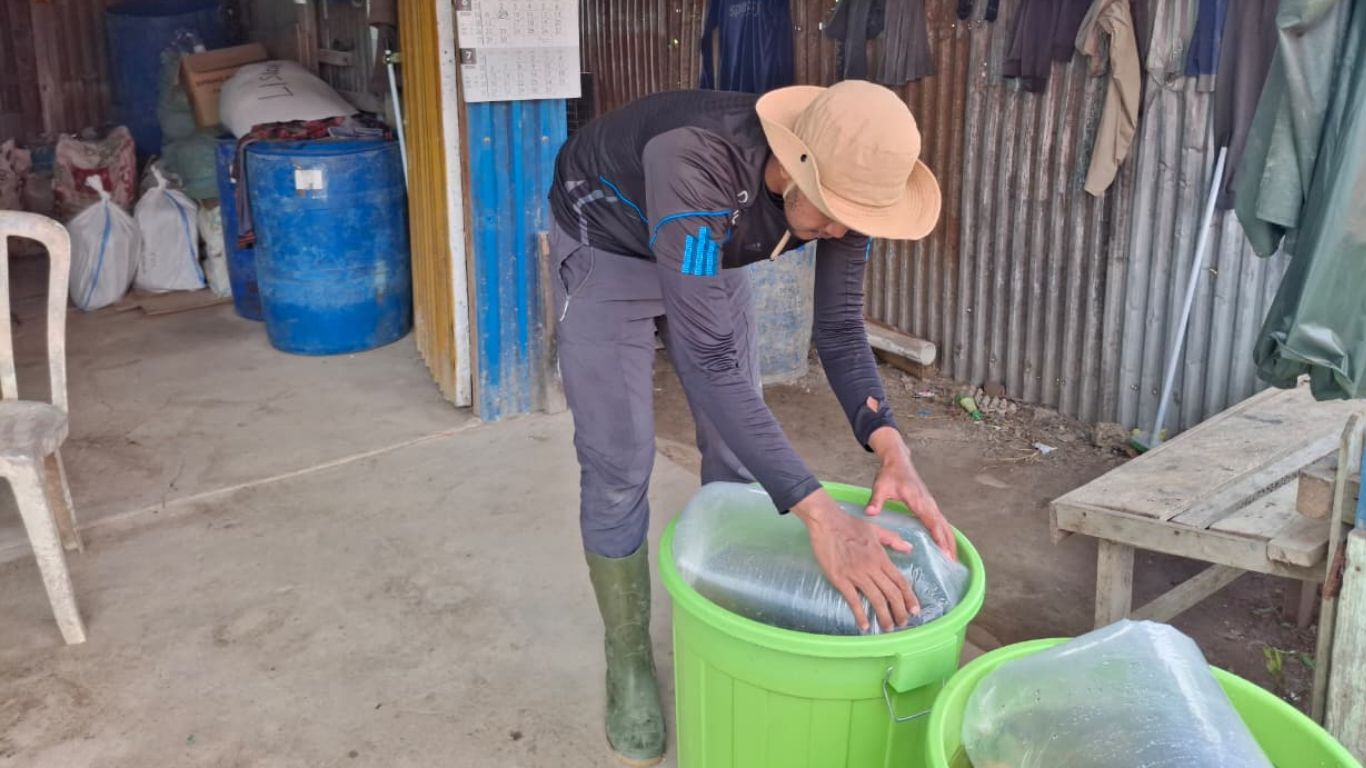
Young fish going through acclimatization before being placed in treated water. Photo Credit: Tay Juhana Foundation/Yogie Bagusti
Integrating the Innovation with the Local Small-Scale Tradition
To ensure the experiment's output can be relevant, cost is also a key factor in small-scale practices. The team envisions the model as affordable and with market potential for local communities. To do so, we first explored ways to use locally available feed sources, such as fish market waste, coconut pulp, and leafy plants, which can be found in and around Kuala Enok. The drums we mentioned earlier were part of our plan to reuse the material to build small-scale hatchery ponds, with the hope of working alongside the local community.
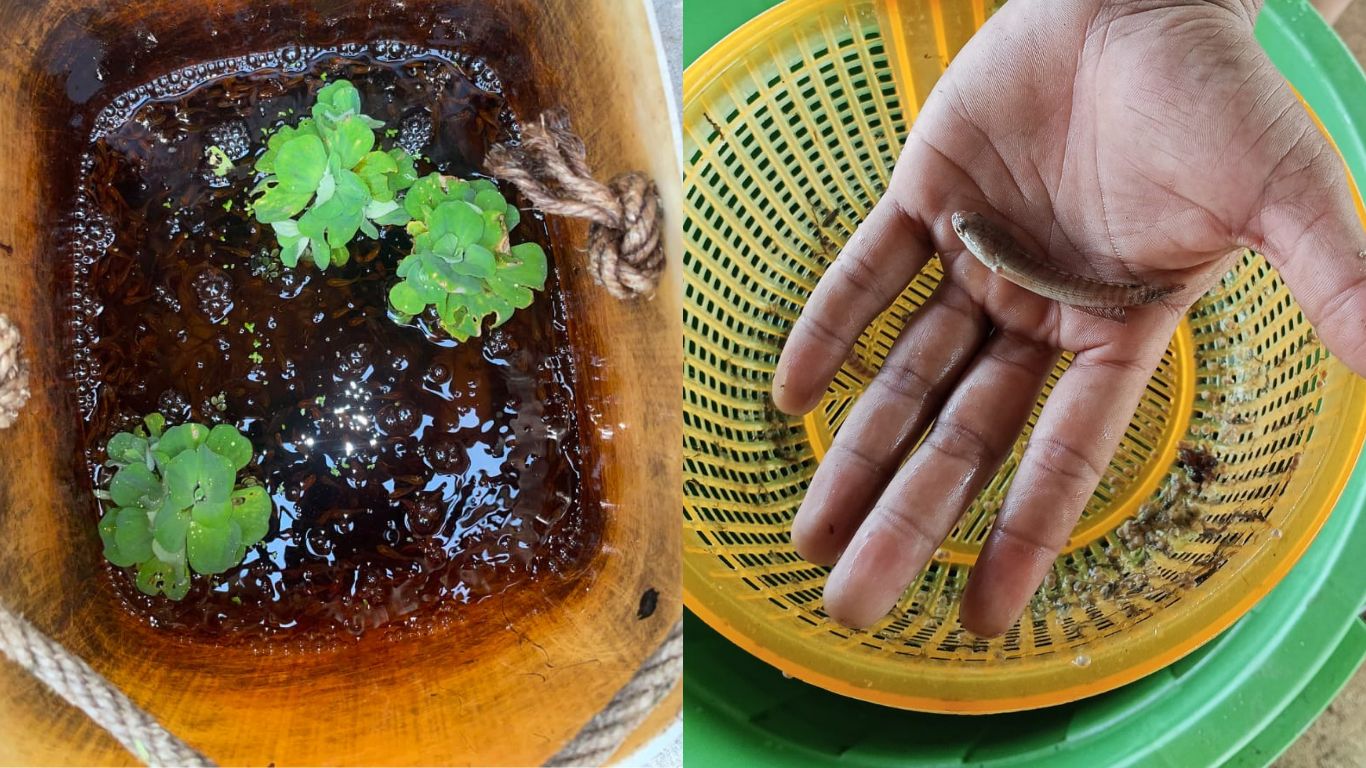
Left: Fish rearing in repurposed plastic drums; Right: Young snakeheads (gabus), a local species. Photo Credit: Tay Juhana Foundation/Raditya Paksi I.
Beyond the pilot, our ultimate goal is an aquaculture model that fits Kuala Enok's land and water conditions and the community's habits, so fish farming becomes part of everyday life rather than something separate from it, aligning with our FOSTER program mission on making local food security resilient, especially on suboptimal land.
At Tay Juhana Foundation, we are committed to advancing food security on suboptimal lands through sustainable agriculture. Follow updates on our integrated agriculture system projects on Instagram and LinkedIn, and learn more in our TJF Research Brief.


RELATED
ARTICLE
Landmark Pluit Building-2nd Floor, Tower D6, RW.4, Pluit, Kecamatan Penjaringan, Jakarta Utara, Daerah Khusus Ibukota Jakarta 14440
Phone: (021) 6603926
WhatsApp: +62 815 8855 584
Follow our social media:


Privacy Policy
Copyrights © 2026 Tay Juhana Foundation