The Degradation of Parit in Indragiri Hilir Today
January 14, 2026 09:03
The Degradation of Parit in Indragiri Hilir Today
Previously in our recent article, we have uncovered parit’s early development where it emerged not merely as an agricultural waterways, but as a living system within the community which is shaped by collective knowledge, tidal rhythms, and generations of care. Since its first construction, parit has anchored everyday life, agriculture, mobility, and the community livelihood access in Indragiri Hilir. However, how is its condition today, after serving decades as the foundation of life in Indragiri Hilir?
Unfortunately, with the intersection of the rising climate change impacts, the rising maintenance costs, and the limited governance, parit’s present condition is beginning to crumble across many villages.
Based on our ongoing ethnographic research, natural degradation caused by rising climate threats which impact parits are becoming increasingly visible across the landscape. Our observations in four subdistricts in Indragiri Hilir show that soil abrasion is the most alarming issue. This is shown by how soil subsidence has become more pronounced which lowers farmland and the gradually rising water level which makes it more prone to flooding. During high tides or heavy rainfall, water lingers longer than it should, suffocating crops, including coconut, and stalling their growth. Local farmers describe the condition where flooded coconut trees survive, but fail to bear fruit as “mucung.” The trees stand, yet productivity disappears.
Water quality has also declined as parit maintenance is declining. Without regular maintenance, tidal flows weaken, trapping water where it should move freely. In several parit, stagnant water has allowed acidic conditions to intensify, marked by floating residue such as pyrite on the water’s surface. Over time, it affects soil fertility and undermines the very purpose of the parit itself, which is to regulate water so the land remains cultivable.
Yet, natural degradation is only part of the story. The economic burden of maintaining parit has also risen sharply along with it. Strengthening and cleaning tanggul (the dike) to buffer the rising water level and restore the parit’s prime function require resources that many farmers find burdensome. Maintenance is costly, and its outcomes uncertain. Even after investing time and money, flooding can still occur, crops can still fail, and losses remain a constant risk.
For many households, this uncertainty forces difficult choices. Some attempt to sell their land. Others shift from coconuts to commodities perceived as more resilient, such as oil palm. Many simply abandon their farms altogether. What follows is a quiet chain reaction: abandoned land turns into overgrowth, attracting pests like monkeys, squirrels, and rhinoceros beetles. These pests do not remain contained. Rather, they spread to nearby farms, damaging healthy crops and deepening losses for those who stay.
As the parit deteriorates, so too does the social fabric that once sustained it.
Historically, parit governance relied on collective responsibility, led by a Wakil Parit and reinforced through musyawarah. This system worked very well when parit was still central to daily life, when people lived close to their farms, depended directly on the waterways, and shared a sense of ownership over their maintenance. Today, that reality has shifted along with modernization.
Many residents have moved away from parit areas, relocating to denser areas (now villages). Younger generations increasingly seek livelihoods outside agriculture. While the role of Wakil Parit still exists, its authority is stretched thin, overwhelmed by the scale of challenges and the lack of external support. Government attention remains limited, leaving communities to rely largely on swadaya, self-funded and self-organized efforts that are no longer sufficient to meet today’s challenges.
And yet, despite all this, parit has not lost its meaning.
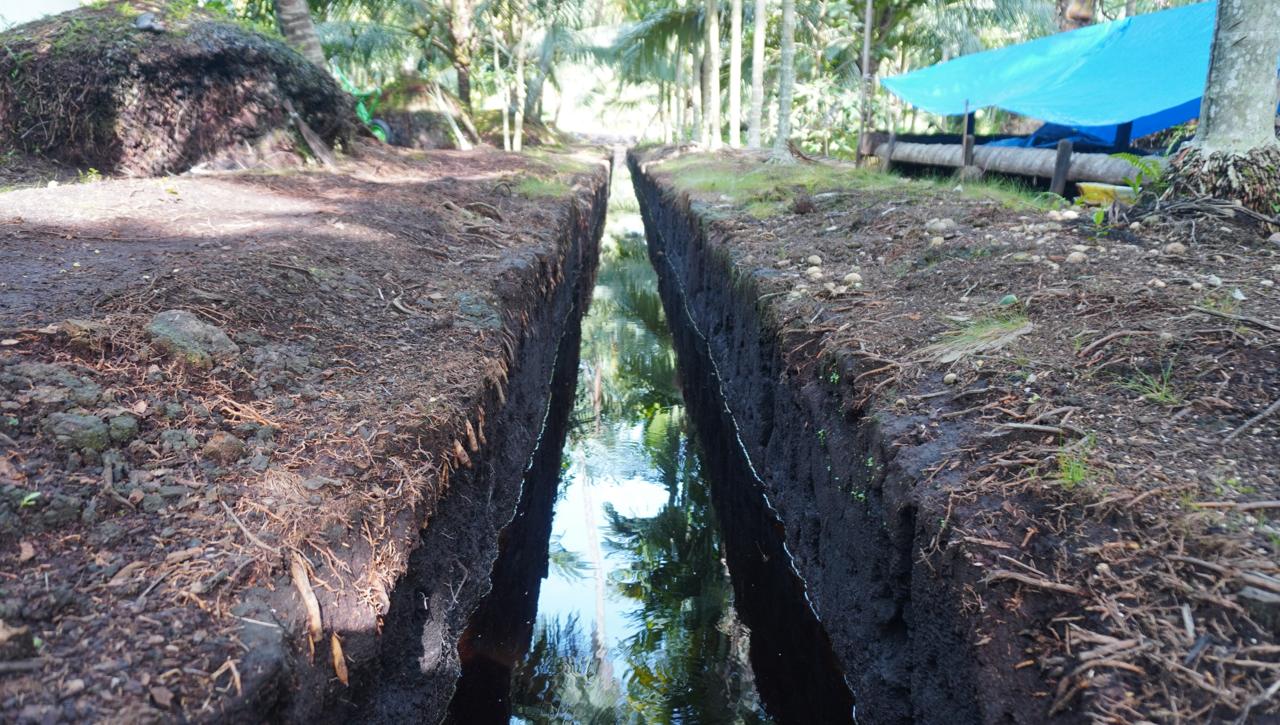
For many farmers, parit is a make-or-break system. Its condition determines whether they can continue farming for their livelihood on that land or not. As one farmer in Sapat put it, “Without parit, there is no farm. Parit is the heart of farming here.” This view is shared across villages, not as nostalgia for the past, but as a reality farmers are living with today.
Recognizing this reality means rethinking how parit is approached. Addressing its challenges requires more than technical repairs. It calls for renewed attention to parit as a living system, one that depends on ecological balance, collective governance, and economic resilience. Strengthening community deliberation through musyawarah with the functional expansion of Wakil Parit, restoring natural buffer zones like mangrove and nipah that once protected waterways, and reducing the community’s economic vulnerability through diversification of livelihoods can help ease the pressures facing parit today.
The future of parit in Indragiri Hilir is not predetermined. While its current condition reflects strain, it also reveals what is at stake. Sustaining parit means sustaining the relationships that allow water, land, and community to function together. In a landscape shaped by tides, the question is not only how parit can be repaired, but whether it can once again be recognized, and supported, as the foundation of life it has long been.
To explore these challenges and pathways in more depth, read our latest TJF Brief on parit in Indragiri Hilir. Also, follow Tay Juhana Foundation on Instagram and LinkedIn for ongoing updates from our research and fieldwork!
Category
Research Article
Topic
Agriculture
Food Security
Governance
Peatland Agriculture Sustainability
Suboptimal Land
Landscape
Livelihood
Peatland
Suboptimal Land
Share This Article


RELATED
ARTICLE
Landmark Pluit Building-2nd Floor, Tower D6, RW.4, Pluit, Kecamatan Penjaringan, Jakarta Utara, Daerah Khusus Ibukota Jakarta 14440
Phone: (021) 6603926
WhatsApp: +62 815 8855 584
Follow our social media:
![[object Object]](/icons/instagram.svg)
![[object Object]](/icons/facebook.svg)
![[object Object]](/icons/youtube.svg)
![[object Object]](/icons/linkedin.svg)
Privacy Policy
Copyrights © 2026 Tay Juhana Foundation